Introduction to Diversity, Equity, & Inclusion
What is diversity? Before we dive into this topic, let’s see what springs to mind when you hear the word “diversity”. Brainstorm This course is about Diversity, Equity, and Inclusion (DEI). Which notions do you associate with ‘Diversity’? [Insert link to wordcloud site] to brainstorm your ideas into a word cloud. There’s no need to register, you can choose to skip that. You may leave as many entries as you want. Single words work better than phrases.
[Insert link to wordcloud result page] to look at the resulting word cloud, where you can see which words came to mind for the other participants in this course. Note that there are no “correct” answers. The more frequent the word, the larger it appears in the cloud. What do you notice?
Definitions
Now we will consider a variety of definitions of the word “diversity”. Read the following definitions:
Measures of diversity typically include the numbers and proportions (the ‘representation’) of different demographic groups at different levels or in different roles in an organisation… [However], diversity itself is not enough to create an inclusive culture.” Inclusion is about how people perceive and experience the place they work in, and whether they feel safe, respected and that they belong. (Royal Academy of Engineering, 2018, p. 25)
A more adequate understanding of inclusion requires attention to the complex, dynamic, and intersecting identities that all learners and teachers bring to the pedagogical experience…. Thomas and May (2010) [highlight] that all students bring to bear complex constellations of attributes and experiences that vary from those of their peers and from proposed ‘normative’ standards… They thus argue for an approach to inclusion that doesn’t target particular groups, but instead strives towards proactively making higher education accessible, relevant and engaging to all students (Lawrie et al., 2017, p. 2)
Diversity refers to the variety of similarities and differences among people, often called diversity dimensions… Intersectionality refers to complex ways in which individuals hold many marginal group affiliations at the same time. These identities can combine, overlap, or intersect in a person or group, resulting in multiple, interdependent systems of discrimination or oppression… Inclusion is a dynamic state of feeling, belonging, and operating in which diversity is leveraged and valued to create a fair, healthy, and high-performing organization or community. An inclusive culture and environment ensure equitable access to resources and opportunities for all. It also enables individuals and groups to feel safe, respected, heard, engaged, motivated, and valued for who they are. (Molefi et al, 2021, pp. 4-5).
The definitions you’ve just read all share certain values, for instance, the right for individuals to be respected and heard. Many authors emphasise that diversity does not just refer to characteristics that people typically think of, such as race, gender, or age. Other aspects of diversity, which are sometimes less easily visible, play a role as well.
Gardenswartz and Rowe (2003) depict diversity as a wheel with different, rotating layers. Several dimensions of diversity can intersect at any one time. Take a close look at the diagram below. Which aspects of diversity do you notice here that you hadn’t thought of before? How do the various dimensions interrelate? 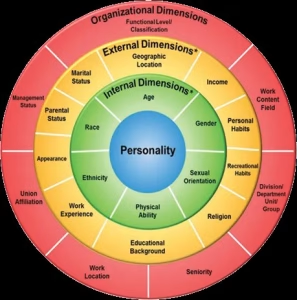
Diagram reproduced from Matkin et al., 2023 under the Creative Commons Attribution-NonCommercial 4.0 International License
References
Gardenswartz, L., & Rowe, A. (2003). Diverse Teams at Work: Capitalizing on the power of diversity. Society for Human Resources Management.
Lawrie, G., Marquis, E., Fuller, E., Newman, T., Qiu, M., Nomikoudis, M., Roelofs, F., & Van Dam, L. (2017). Moving towards inclusive learning and teaching: A synthesis of recent literature. Teaching & Learning Inquiry 5(1). Available at: http://dx.doi.org/10.20343/teachlearninqu.5.1.3
Matkin, G. S., Headrick, J., & Sunderman, H. M. (Eds.). (2023). Developing Human Potential: A Personal Approach to Leadership. Department of Agricultural Leadership, Education, & Communication at the University of Nebraska – Lincoln. https://doi.org/10.32873/unl.dc.oth.015
Molefi, N., O’Mara, J. & Richter, A. (2021). Global Diversity, Equity & Inclusion Benchmarks. Standards for Organizations Around the World. Available at: https://centreforglobalinclusion.org/file_download/inline/a1564bf0-9b5d-469a-a516-c6d438c79609
Royal Academy of Engineering (2018). Creating cultures where all engineers thrive. A unique study of inclusion across UK engineering. Available at: https://www.raeng.org.uk/publications/reports/creating-cultures-where-all-engineers-thrive