
A Closer Look at CVE
Mirjam Hauck’s Framework
Hauck (2023) regards CVE as a ‘nascent field in VE practice and research’, i.e. there is a growing awareness of critical aspects in developing and running VE.
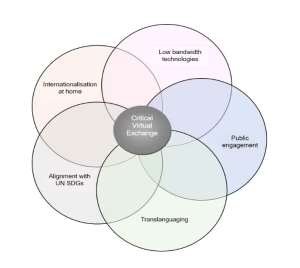
The framework she proposes makes a distinction between the following elements:
- * Low-bandwidth technologies: many of us (teachers, students) work in technologically sophisticated institutional environments, but when working with partners it is essential to consider the technologies which are available and accessible in the environments in which they teach and learn. Aiming for low-bandwidth technologies, considering whether videoconferencing is realistically possible or whether more asynchronous collaborations should be targeted are key concerns in the CVE design process.
- * Internationalisation at Home: IaH is “the purposeful integration of international and intercultural dimensions into the formal and informal curriculum for all students within domestic learning environments” (J. Beelen & E. Jones, 2015). It is aimed at giving all students in the institution, not only those going abroad, international and intercultural learning experiences. VE is well placed in this context, but Hauck (2023) reminds us that students from low socio-economic backgrounds may be underrepresented in such contexts. And there may be other aspects to consider when providing VE as inclusive internationalisation for all students.
- * Alignment with UN SDGs: The UN Sustainable Development Goals (https://sdgs.un.org/goals) feature prominently in HE strategies and policies. Because it connects learners across the globe, VE facilitates collaborative, challenge-based learning on topics related to the SDGs.
- * Public engagement: Public engagement, in terms of the framework, concerns relating to and working with (local) community, businesses, NGOs, and charities to address local issues from global perspective.
- * Translanguaging: Translanguaging, finally, derives from a concept in linguistics, but here it is understood in the broader sense of encouraging learners to use the different languages and meaning-making resources at their disposal. This includes written and spoken text, images, audio and video recordings, songs, etc. – allowing the learners to use the whole range of multimodal and multilingual ways of expressing themselves, and breaking through the hegemony of English which is characteristic of much international communication.
Please watch this linked video to learn more about Critical Virtual Exchange:
Introduction to Critical Virtual Exchange © 2025 by ROCKET Project is licensed under CC BY 4.0
Note: Toggle the CC button for captions in English. Click on the gear button and choose higher resolution settings to best view the screen.
Additional resource (optional):
If you are interested in learning more about the CVE framework, you may view a presentation for the ROCKET project by Mirjam Hauck herself. Click here to watch the recording, starting at the point where she introduces the framework.