
Examples of CVE Projects
Humanitarian problems in Syrian refugee camps
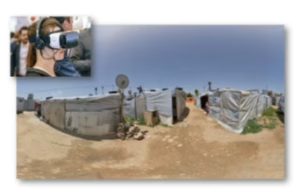
An excellent example of a CVE project is described in the Bowen et al. (2021). It reports on a VE project in global health in which university students in the U.S. are connected with peers in Lebanon, who worked in teams to address humanitarian problems in Syrian refugee camps. The authors aimed at developing “socially responsible best practices for study abroad”, which were “designed for mutual and equitable benefits”. And which “focused on locally identified needs and priorities, attentive to local community costs, and structured to build local capacity to ensure sustainability.” It should be clear from these citations how this VE project addresses several component elements of the CVE framework.
Additional reading (optional):
If you are interested in learning more about this project, please check out the linked article here.
Bowen, K., Barry, M., Jowell, A., Maddah, D., & Alami, N. H. (2021). Virtual Exchange in Global Health: An innovative educational approach to foster socially responsible overseas collaboration. International Journal of Educational Technology in Higher Education. Link here.
Reading the city
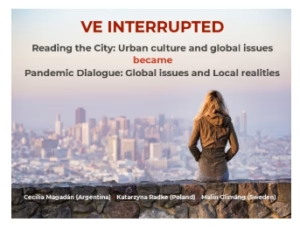
Another example of VE, referenced in Hauck (2023), is Reading the City. This is a project which started during the COVID-19 pandemic and has since then gone through several iterations. It involves three teachers (Cecilia Magadán, Katarzyna Radke, Malin Reljanovic Glimäng) from Argentina, Poland and Sweden. Working together in transnational teams, their students researched urban sustainability challenges and designed educational campaigns for each of the three cities on sustainability actions, including promoting clean air and water, saving the bees, recycling, and campaigning for women’s safety in urban environments.
Additional reading (optional):
If you want to learn more about this project, and research conducted in its context, the following article will be of interest:
Reljanovic Glimäng, M. (2022). Safe/brave spaces in virtual exchange on sustainability. Journal of Virtual Exchange, 5, 61-81. Link here.
Further examples (Uppsala, Groningen, Göttingen)
Closer to home (for participants in this course) are projects conducted by colleagues from Uppsala, Groningen and Göttingen.
- * In Uppsala, Fanny Jansson coordinated the Erasmus+ VAMOS project, a capacity building project with Latin American partners, using virtual exchange to tackle wicked problems. Link to the project here.
- * In Groningen, teachers in the Spanish language team (Beatriz Carbrera Fernández, Gerdientje Oggel and Juan Albá Durán and others) are involved in projects with partners in Mexico and El Salvador, addressing topics related to CVE. Link to the project here.
- * Finally, Fabian Krengel (formerly Göttingen, now Regensburg) focuses in tackling tough topics through VE (telecollaboration) in his English-language classes. For an example, see this linked project.