
All videos are also available in the ROCKET YouTube Channel.
Role Play Games
Josefin Westborg
This video introduces role-playing games (RPGs), explaining their core types “tabletop, live-action (larp), and digital” and how they create a “magic circle” of shared fiction where players embody characters in co-created worlds. It also explores related activities (childhood pretend play, simulations, improv, therapeutic role-play) to show how RPGs blend storytelling, skill training, and identity exploration, fostering agency, empathy, and collaboration in diverse settings. The focus is on their fluid, experimental nature and broad applications, from education to therapy.
Sarah Lynne Bowman, Josephin Westborg, Kjell Hedgard Hugaas
This video features Josefin Westborg facilitating a ROCKET role-playing game scenario for Kjell Hedgard Hugaas and Sarah Lynne Bowman, modelling the methods used in the project for teachers and other learners.
Sarah Lynne Bowman
This video explores how psychological safety and structured techniques can transform educational role-playing into a powerful tool for fostering open engagement and emotional exploration in learning environments. It emphasises the importance of creating spaces where students feel secure to participate, take risks, and reflect on conflicts – even within mandatory settings.
Josefin Westborg
This lecture describes basic strategies for designing educational analog role-playing games, including using existing educational games, designing new ones, or adapting leisure games for learning purposes. Westborg discusses various aspects that enhance learning in RPGs including power distribution; active engagement; putting knowledge into a context and applying it; doing and exploring; embodiment; emotions; adopting a new perspective; establishing a common frame of reference; and cooperation. The lecture explains the game studies concepts of bleed, alibi, and the magic circle with reference to learning. Westborg also discusses some pitfalls with the method. The video closes with aspects that can affect the experience, including props, costuming, mandatory vs. voluntary participation, and post-game debriefing.
Josefin Westborg
This lectures describes basic concepts of transformative role-playing game design as applied in ROCKET conflict transformation scenarios. Westborg emphasizes designing based on goals, as well as the importance of framing the experience before, during, and after the game to make learning transfer more likely. The lecture describes how ROCKET scenarios are built upon the seeds of common core conflicts, including issues with group work dynamics, power, rejection, demands on time, different belief systems, and different needs. Westborg concludes with offering some debriefing prompts to help inspire reflection in participants.
Sarah Lynne Bowman
This video clarifies the distinct role of facilitation in educational role-playing games, highlighting how it differs from both game design and traditional teaching by focusing on guiding participants through immersive, conflict-based scenarios. It introduces practical meta-techniques – such as the Hot Seat, Monologue, and Last Line – to help players embody their characters, escalate conflict for deeper learning, and reflect immediately on their experiences, all while maintaining psychological safety.
Josefin Westborg
This lecture discusses the basics of transformative analog role-playing games. The video defines transformation as 1) a prolonged and sustained state of change; and 2) a process or series of processes that lead to growth. The video explains three types of RPGs: transfomative leisure, educational, and therapeutic. Westborg also discusses a few of the cognitive, affective, and behavioural skills that can be cultivated through RPGs. The lecture emphasizes the importance of framing strategies before, during, and after the game, including safety, workshops, deroling, debriefing, and integration practices. Westborg closes the lecture by introducing key concepts in role-playing game theory, including alibi and bleed.
Conflict Transformation
Sarah Lynne Bowman
This video introduces “conflict transformation”, a peacebuilding approach that views conflict as an opportunity for growth rather than a problem to solve. It explains how “diversity, equity, and inclusion (DEI)” intersect with conflict, emphasizing the need for “ongoing dialogue, co-creation, and systemic change” to address underlying issues like privilege, marginalization, and structural violence. The focus is on “practical skills” such as “reflective listening, perception-checking, and nonviolent communication” to foster “collaborative, long-term solutions” that honor individual experiences while recognizing shared human needs.
Critical Virtual Exchange
Riccarda Fulda
This lecture introduces the concept of critical virtual exchange (CVE), a form of online education involved multiple institutions that brings to the foreground considerations of diversity, equity, and inclusion in content and delivery. Fulda explains how the Hauck’s (2023) envisioning of CVE emphasizes action- and change-oriented practices; critical digital literacy; global citizenship education; and reflection on the hegemonies and technological barriers that can affect learning in virtual exchanges.
DEI
Alexandra Schreiber
This video explores culture as a dynamic mix of visible and hidden norms – like communication styles, values, and problem-solving – that shape identity and interaction. It highlights how stereotypes and social categorisation distort perceptions, and introduces intercultural communication as a tool to bridge differences, fostering empathy and non-judgmental understanding through self-awareness and perspective-taking.
Conferences
Mirjam Hauck
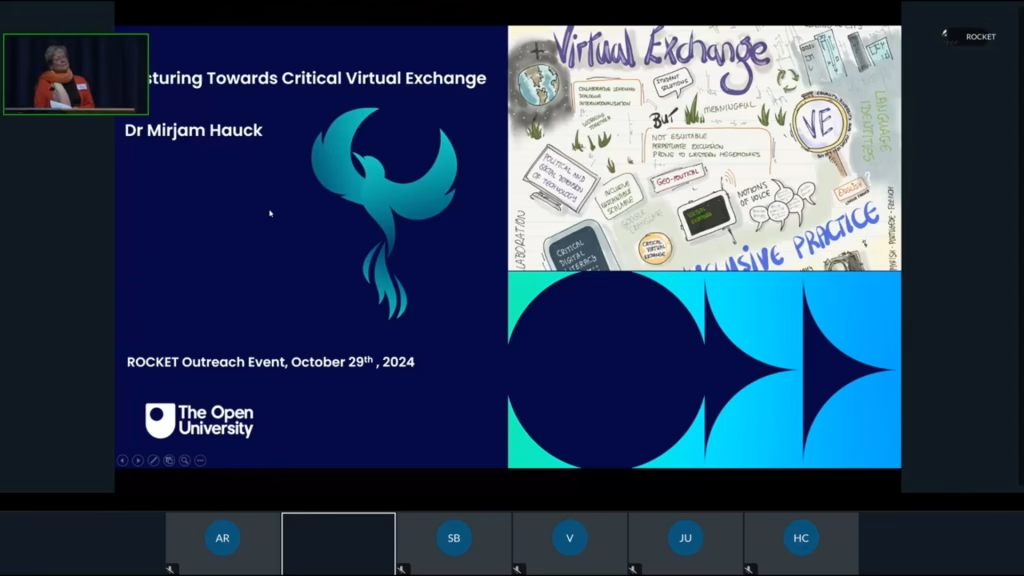
Scholars like Stein and Andreotti (2006) challenge hegemonic discourses, the masking of global complexity, and the perpetuation in education of colonial ideologies, and they encourage us “to think otherwise”. Mirjam Hauck introduces a framework for CVE (Hauck, 2023; in press) that highlights what distinguishes this approach to Internationalisation at Home (Beelen and Jones, 2015; O’Dowd & Beelen, 2021) from VE as we know it, and will present exchange examples from both the Global North and the Global South to illustrate what it means to “gesture towards” (Stein et al., 2020) inclusive and equitable student VE experiences.
David J. Smith
David J. Smith shares his experiences over 20 years in developing and offering experiential learning opportunities to advance peacebuilding and humanitarian education. He talks about the work of the Forage Center, teaching at the Carter School, and looks at the future of experiential and simulation-based learning. He addresses the challenges of teaching skills needed for “in person” activities and professional pursuits in a training world that is increasingly virtual.
Playlist (8 Videos)
This hybrid outreach event was co-funded by the Erasmus+ ROCKET project; the Uppsala Forum on Democracy, Peace and Justice; and Region Gotland. The seminar is hosted by the Transformative Play Initiative in the Games & Society Lab at the Department of Game Design, Uppsala University Campus Gotland. The Transformative Play Initiative explores the use of analog role-playing games as vehicles for lasting personal and social change.
Alejandro Ruiz del So
Alejandro Ruiz del Sol presented on June 12, 2025 at the Transformative Play Initiative Seminar 2025: Games, Conflict, and Education. House rules are typically established at the start of play. But who communicates the house rules? Is there a ritual to establish the rules? Alejandro Ruiz del Sol discusses and defines some of the features of house rules, and argues for the conscious inclusion of house rules as a feature of physical games.
Katie Donahoe
As the Teen Librarian of the Mt. Lebanon Library (Pittsburgh, PA), Katie Donahoe wanted to find a way to combine young role players and storytellers, knowing they would find much in common. She found the Strollplaying game event series to be helpful in building mindfulness skills, and to experience the familiar in new ways. This allowed the teens to build community outside of the four walls of the library, learning about themselves together, while also being in a safe, chaperoned environment.
Uppsala University
At first glance, role-playing games may seem like fantasy and fiction, but new research suggests that they can be a useful tool for managing conflicts and even strengthening democracy.
This video features footage from a workshop held as part of the Erasmus+ project ROCKET at the “Transformative Play Seminar 2025: Games, Conflict, and Education” in Visby, which is also co-funded by the Uppsala Forum for Democracy, Peace and Justice. Other projects featured in the video include Horizon Europe’s Larpocracy and Erasmus+ EDGE.