
Conflict Styles
Take the Conflict Styles Inventory from Evocative Games AB linked in this module and tally your scores. Make note of your tendencies for ways in which you handle conflict in times of Calm and times of Storm. As discussed in the Positions, Interests, Feelings, and Needs module, conflict arises when our needs feel unmet or threatened. Conflicts that allowed to escalate often result in violence. Whether examining conflict in our personal lives or between groups on a global stage, we notice five main styles of dealing with conflict. These styles were first developed by Kenneth W. Thomas and Ralph H. Kilmann in 1974 with further elaboration by Ronald S. Kraybill in the 1980s. The information below has been adapted from these models. These positions are often considered with regard to how deeply one values the goal, the relationship, both, or neither. We can envision these styles falling along two axes:
- Assertiveness, which focuses upon one’s own needs, desired outcomes, and agenda; and
- Cooperativeness, which focuses upon others’ needs and mutual relationships.
These Conflict Styles are:
* Competing: With competition, one perceives conflict as a fight in which “winners” succeed over “losers” in a zero-sum power struggle. Competitors tend to exhibit greater concern for asserting their needs and goals over their relationships with others.
* Avoiding: Avoiders try to escape any sort of confrontation with the conflict by withdrawing from the situation. They often attempt to maintain neutrality in conflict situations. They may not feel strong concern for either the goal or the relationships involved.
* Accommodating: Accommodators try to keep relationships running smoothly and avoid conflicts erupting. They tend to accede to the requests of others in order to maintain harmony. They may “walk on eggshells,” often demonstrating greater concern for the relationship than the goal of getting their needs met.
* Compromising: Compromisers try to find a way to resolve conflicts by giving every party a portion of what they request so that the resolution is minimally acceptable to everyone concerned. Compromising is a way to balance showing concern for one’s goal and the keeping the relationship undamaged. Inherent to compromising, though, is each party also not getting a portion of what they request, which can feel unsatisfying or fail to fully resolve the conflict.
* Collaborating: Collaborators seek to achieve the win-win outcomes for all parties involved. Also called Problem Solvers, they spend time and energy imagining creative solutions to the conflict, working together to ensure that all parties feel heard in the process and their needs met. This process expands the range of possible outcomes. Collaborators show both high regard for the goal and or the relationship.
Note that some conflict styles are appropriate in certain situations than others. While Collaboration is a great goal, sometimes it is impractical, particularly if a time constraint exists or if the other party is not willing to work together.
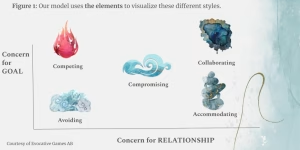
Figure 1. The Thomas-Kilmann Conflict Modes. Out model uses the elements to visualize these different styles: Fire (Competing), Air (Avoiding), Earth (Accommodating), Water (Compromising), and Space (Collaborating) The vertical axis represents concern for goal, whereas the horizontal axis represents concern for relationship.
* Fire (Competing): High concern for goal, low concern for relationship
* Air (Avoiding): Low concern for goal, low concern for relationship
* Earth (Accommodating): Low concern for goal, high concern for relationship
* Water (Compromising): Moderate concern for goal, moderate concern for relationship
* Space (Collaborating): High concern for goal, high concern for relationship
Reflect upon your results on the Conflict Styles assessment now that you have learned about these types.
* What times can you remember in which you have used each of these styles?
* What styles do you think would be advantageous in certain situations if you cultivated them within yourself?
* What styles have been less helpful for you in conflict situations?
References
Conflict Resolution Education. N.d. “Conflict Styles.” Understanding Conflict Management.
Kilmann, Ralph. 2024. “Take the Thomas-Kilmann Instrument (TKI).” Kilmann Diagnostics.
Kraybill, Ronald S. 2024. “Compare Style Matters and The Thomas-Kilmann Instrument.” Riverhouse ePress.