Diversity and Conflict
Welcome to our module on Diversity and Conflict! In this module, we will discuss various aspects of diversity that affect people, meaning facets of our social identity that affect how we are viewed in society and our social status.
Gardenswartz and Rowe (2003) depict diversity as a wheel with different, rotating layers. Several dimensions of diversity can intersect at any one time.
Take a close look at the diagram below.
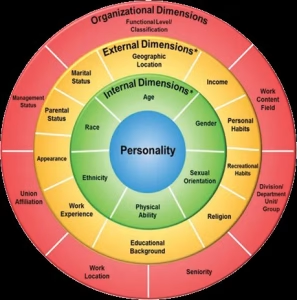
Figure 1: Diagram reproduced from Matkin et al. (2023) (CC BY-NC 4.0)
In the center of the Diversity Wheel is personality.
The next ring focuses on Internal Dimensions, such as age, gender, race, ethnicity, sexual orientation, and physical ability.
The next ring emphasizes External Dimensions, such as geographic location, income, personal habits, recreational habits, religion, educational background, work experience, appearance, parental status, and marital status.
The outer ring focuses on Organizational Dimensions, such as the functional level/one’s classification, the work content field, the division/department/unit/group, seniority, work location, union affiliation, and management status.
- Which aspects of diversity do you notice here that you hadn’t thought of before?
- How do the various dimensions interrelate?
References
Gardenswartz, Lee, and Anita Rowe. 2003. Diverse Teams at Work: Capitalizing on the power of diversity. Society for Human Resources Management.
Matkin, Gina S., Jason Headrick, and Hannah Sunderman, eds. 2023. Developing Human Potential: A Personal Approach to Leadership. Department of Agricultural Leadership, Education, & Communication at the University of Nebraska – Lincoln. [Link here]