
Whole-Institution Resources
Outline
In the first part of this module, we would like to focus on existing resources, which you may already be familiar with. These resources can aid a diverse university population, which includes students, academic staff, and non-academic staff, to overcome existing barriers. The good news is that universities often have a number of resources in place that can be drawn on for support. The bad news is that individual actors may not always be aware of where to find these resources. In this discussion, we thus invite you to think about which resources are available to you and any students or teachers you may interact with.
The Whole-Institution Principle
Connecting different actors between institutions and within one institute is known as the “whole-school approach”.
As the Rethinking Learning Initiative explains, “[w]hole school approaches broaden the focus of school-based interventions beyond the explicit curriculum to include the people and contexts that support” learners’ progress holistically” (Singh and Duraiappah, eds. 2020). Accordingly, the ROCKET project considers the following resources where actors within higher education may find support:
- * Antidiscrimination services
- * Career development offices and leadership organizations
- * Counselors of all kinds
- * Disabilities department staff
- * Equal opportunities groups
- * Health services
- * International Offices / counseling and connection opportunities for international students
- * Learning labs and writing centers/ workshops
- * Life-long learning opportunities
- * Psychological counseling
- * Resources for parents on campus
- * Student associations
- * Study administrators and advisors
- * Tech Services
Below, you can find a project example of what a Whole-Institution Map may look like at the University of Göttingen:
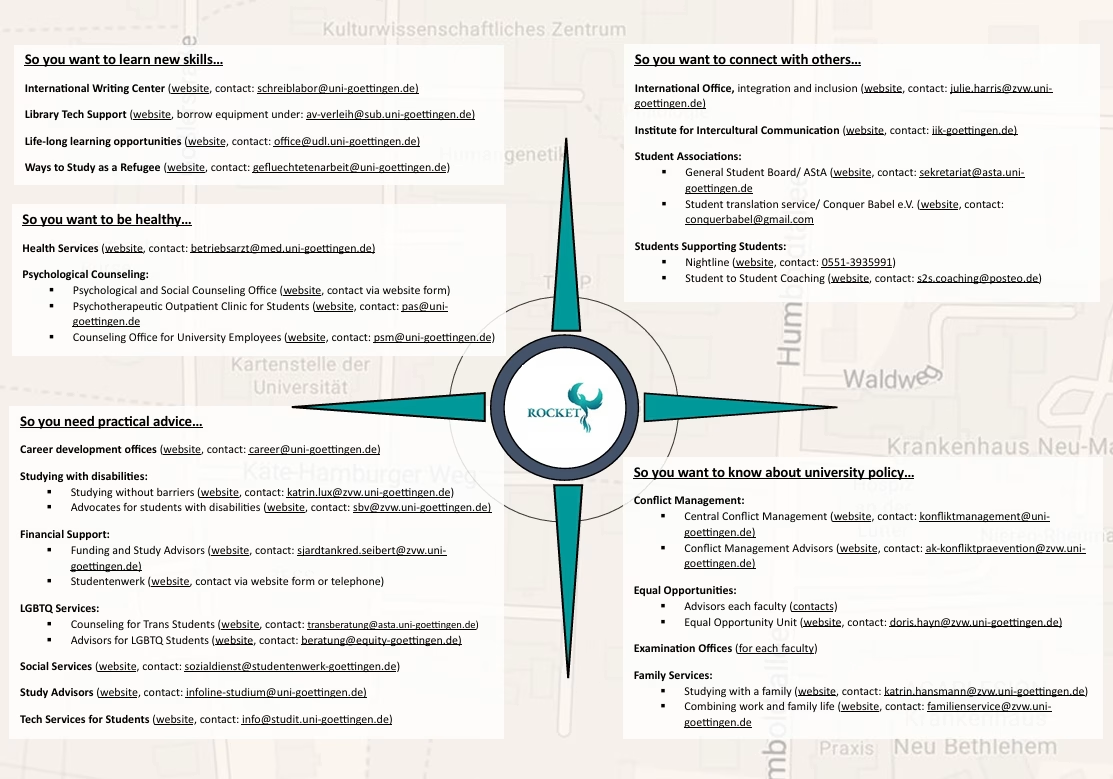
Overviews like these can be found on many institutional websites, directing their readers to a range of helpful offers. For instance, the University of Groningen offers a similar flowchart, while resources from Uppsala University can be downloaded on the following page. In the following, we will introduce you to a new tool you may use, before we ask you to share your own experience.
References
Singh, Nandini Chatterjee, and Anantha Duraiappah, eds. 2020. Rethinking Learning: A Review of Social and Emotional Learning for Education Systems. UNESCO.